
brows too dark after a post-lift tint? here's the correction
A brow that runs 2 to 3 shades darker than expected after a same-session tint isn't a color choice mistake — it's chemistry. Step 1 opened the cuticle, and pigment absorbed 3 to 5 times faster than it would on virgin hair. Cut the pose time, plan the correction protocol, and prevent it next time.
an open cuticle drinks pigment 3 to 5 times faster
Post-lift hair isn't the same substrate you tinted last week. Step 1's reducing chemistry — ethanolamine thioglycolate at pH 9 to 9.5 — broke the disulfide bonds inside the cortex and mechanically forced the cuticle scales open. The hair stays in that structurally altered state through the rest of the session.
Direct result: oxidative pigments (p-phenylenediamine, m-aminophenol) drive into the cortex much faster and deeper than they would on healthy virgin hair. A hair that would saturate in 5 to 8 minutes under normal conditions saturates in 1 to 3 minutes post-lift. Applying your regular tint timing on this substrate is how a "medium brown" reads as "black" at removal.

the two timing errors that produce over-saturation
Nearly every case of "too dark" after a same-session tint traces back to one of these two errors. Both are chair-side, both are avoidable, and both fix themselves the moment the esthetician internalizes what post-lift chemistry actually did to the hair.
Error 01 — Applying the standard tint timing
The reflex to keep the tint on for 5 to 8 minutes because "that's the normal pose" is the single biggest cause. That timing is correct for tint-only services on healthy hair. On a hair whose cuticle just came out of Step 1, that same timing crashes past the saturation threshold well before the timer rings. The reflex isn't wrong — the context changed. Post-lift tint needs its own timing bracket, not the standard one.
Error 02 — Not clearing all Step 1 residue before the tint
Any alkaline trace left behind from Step 1 keeps the hair in a state of maximum absorption. Even after Step 2 neutralization, residual pH-9+ molecules on the surface amplify pigment uptake. A rinse with clear water followed by a precise wipe with a damp cotton pad, between Step 2 and the tint application, is non-negotiable. Skip it and you're layering fresh tint on top of a hair that's still chemically "open."
Rinse-and-wipe between Step 2 and tint is not optional
Standard sequence: Step 1 → Step 2 → clear water rinse → careful wipe with damp cotton pad → visually confirm brow is neutralized and residue-free → tint application at the reduced timing. Skipping the rinse-and-wipe to save 90 seconds is how you end up spending 10 minutes correcting a brow that went darker than the client wanted.
which hair profiles run the highest saturation risk
Post-lift porosity isn't uniform across clients. Some profiles absorb pigment faster than others even on a well-executed lift, and those are the profiles where the standard tint timing produces the worst outcomes. Reading the risk before the tint touches the brow is the difference between a client leaving thrilled and a client leaving with brows two shades darker than she asked for.
| Hair Profile | Saturation Risk | Post-Lift Tint Timing |
|---|---|---|
| Fine / sparse | Very high | 60 seconds max |
| Previously tinted or bleached | Very high | 60-90 seconds |
| Sensitized (repeat lifts under 5 weeks) | High | 60-90 seconds |
| Normal / medium density | Moderate | 1-2 minutes |
| Thick / coarse / resistant | Low | 2-3 minutes |
Even on the most resistant hair, 3 minutes is the cap
Thick coarse virgin hair tolerates the top end of the bracket, but 3 minutes is a hard ceiling. Anything past that starts producing localized over-saturation at the tips (which are always more porous than the roots) even when the roots look correct. If you're tempted to push past 3 minutes because "the color's not showing yet," check whether the Step 1 residue was fully cleared before you applied — that's the actual variable, not the timer.
in-session rescue protocol: when the brow comes off too dark
The moment you remove the tint and the brow reads darker than the target shade, act immediately. Every additional minute lets more pigment fix in the cortex. The 4-step protocol below is the standard rescue sequence, in order, without skipping.
Never apply peroxide or a lightener to correct post-lift tint
Reflex idea when the tint went too dark: bleach it lighter. Do not. Any chemical lightening in the 6 to 8 weeks following a lift compounds the cortex damage, weakens the fiber, and produces breakage that no repair protocol reverses. If the tint remover and castor oil sequence didn't get you where you needed, the correction moves to the home routine — daily cleansing, oil massage, and time. Bleach doesn't belong anywhere in this scenario.

Tint Remover
Sodium sulfite formulation designed to reduce oxidative pigments without damaging the keratin structure. The chair-side rescue for over-saturated brows: gentle enough for post-lift use, targeted enough to actually shift the shade back toward the target. Stock it near your Step 2 so you never scramble mid-session when a tint reads darker than expected.
Shop Tint Remover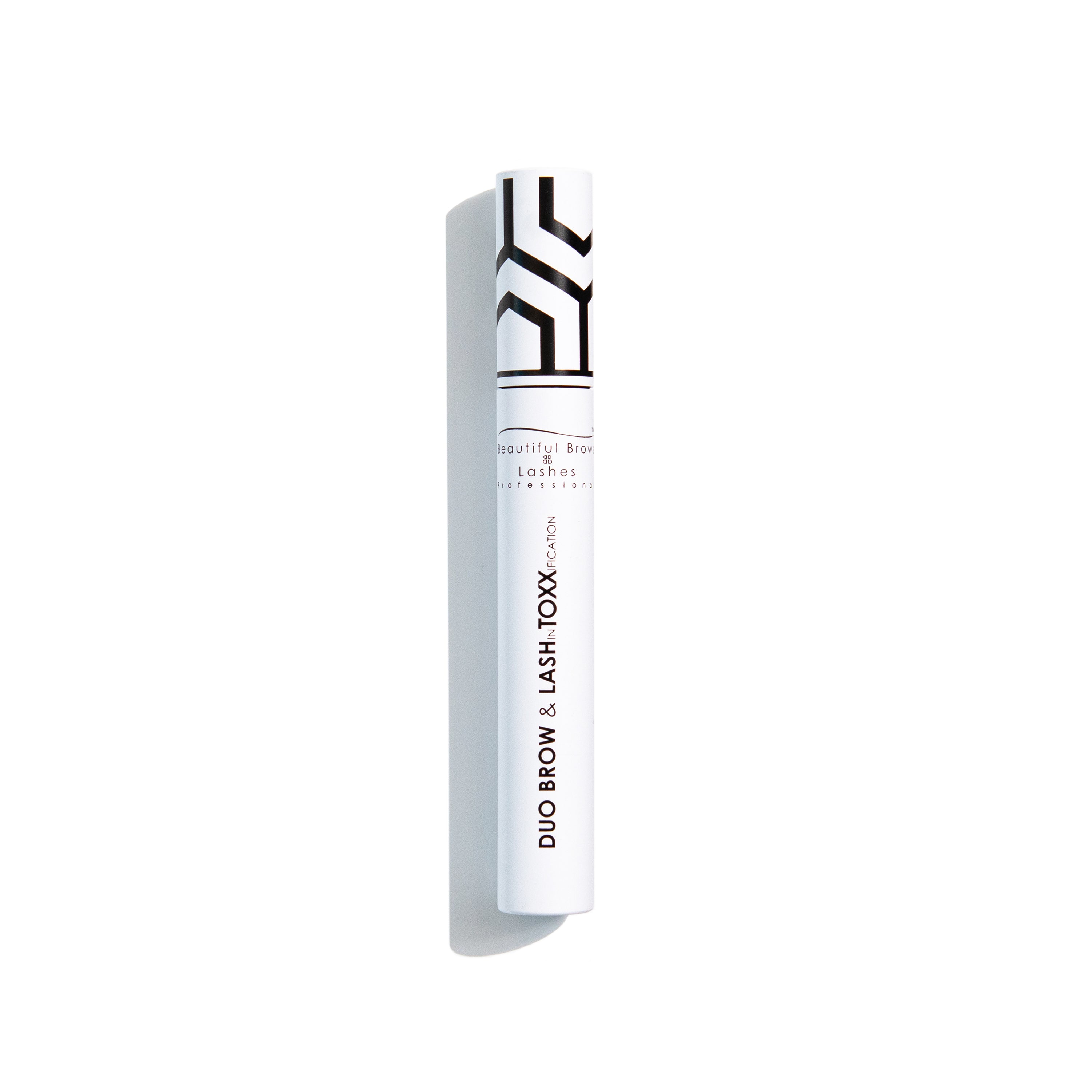
DUO Brow & Lash InTOXXification
The conditioning leave-in that closes the sequence: seals the cuticle after the tint remover pass, restores hydration to a fiber that just took three chemical steps, and prevents residual pigment migration overnight. Send the client home with it — the recovery from a corrected tint is a routine, not a one-time application.
Shop The Toxx Serumprevention: the three levers that make the correction unnecessary
Every case fixed at the chair is a case that could have been avoided at the consultation. Three practices, adopted systematically, eliminate the vast majority of "too dark" outcomes before they happen.
Go one shade lighter, systematically
The rule to internalize: whatever shade the client would normally book, drop one step. Medium brown becomes light brown, light brown becomes ash blonde. The lift chemistry amplifies pigment by the shade the client would have picked without the lift — deliver that by starting one lighter.
Start the timer at 60 seconds, always
Regardless of hair type, the first check-in is at 60 seconds. Assess under strong natural light. Extend by 30-second increments only if under-saturation is confirmed visually. Never set a 3-minute timer and walk away — that's how brows go past the target in silence.
Read the history at intake
Previously tinted, previously bleached, or repeat lifter under 5 weeks? Move directly to the 60-90 second bracket without deliberation. The intake form should surface these flags automatically — don't rely on the client to remember to mention them.
Precision-control tints exist specifically for this scenario
Some tint formulations pair hydrogen peroxide with paraffin oil to deliver a more adjustable, easier-to-control result than classic oxidative tints. On very fine hair, previously treated hair, or clients who've been "too dark" more than once, switching to a precision-control formula is worth the extra product cost. The margin gained on avoided corrections and repeat visits pays for it within a handful of services.
keep exploring the SOS troubleshooting silo
Post-lift over-saturation is one specific SOS scenario. If the client walked in with a different issue — a lift that dropped, damaged fiber, or a skin reaction — the sibling guides below cover the rest of the recovery library.
The rest of the SOS diagnostic library
SOS Brow Lift: Fixing Lamination Mistakes
The master SOS troubleshooting guide covering every kind of brow lamination mistake. Start here if you're not sure what went wrong.
Read the guide → Sibling GuideFrizzy or Fried Tips: The Solution
The over-processing recovery framework. When the fiber itself got damaged — how to nurse it back to a workable baseline.
Read the guide → Sibling GuideMy Brow Lift Didn't Last: Checklist of Causes
The retention failure diagnostic — 11 causes of a brow that dropped too fast, ranked by impact, with the fix for each.
Read the guide → Sibling GuideAllergic Reaction or Redness: What to Do
When the damage is on the skin instead of the hair. Sensitivity, contact reactions, and the response protocol.
Read the guide →chair-side questions you'll get on this scenario
Why do my client's brows look darker after the lift than they did after a plain tint last month?
How long should the tint stay on after a lift?
Can I bleach or lift the brows to correct them if they're too dark?
Should I still patch test a client who's been tinted many times without any reaction?
What if the client's tint history has never included a lift, and this is her first same-session service?
Does the tint remover damage the fiber?
Should I bill the client for the correction time?
Is there a same-session alternative that reduces the risk entirely?
the rescue protocol works if the products are on hand
Tint remover and repair serum on the shelf next to Step 2 — not in a back-cupboard box. Fixing an over-saturated brow at the chair takes 8 minutes when the tools are within reach, and 30 minutes when they're not.
Shop The Lamination Kits