
over-processed brow lamination: how to fix it in 8 weeks
Your client's brows came out cottony, kinked, or snapping at the tips. The good news: it's almost always reversible. The bad news: more product won't save them. Here's the protocol that will.
stop laminating. start rebuilding.
Frizzy or burnt tips after a brow lamination signal one thing: Step 1 broke more disulfide bonds than the hair could rebuild between sessions. The hair isn't dead, but it's structurally depleted. Recovery means a strict 6 to 8 week chemical pause, daily hydrolyzed keratin, and a protein-to-moisture balance. Skip any of those three and the new growth comes in just as fragile.
what's actually happening to the hair
No flame, no heat tool, no scorched edges. The damage is purely chemical, and it sits inside the cortex where you can't see it until the lamination is already done. Three forces compound to produce frizzy or fried tips, and they all trace back to one decision: how long Step 1 stayed on, and on what kind of hair.
The bond chemistry behind every brow lamination
Every certified brow lift on the US market relies on the same chemistry. A reducing solution (Step 1) opens the disulfide bonds in the cortex so the hair can be reshaped, and an oxidizing solution (Step 2) closes them in the new position. The two reducers you'll see on shelves are ammonium thioglycolate at pH 8 to 9.5, and the gentler cysteamine at pH 6.5 to 8. Different pH, different speed, same target: the bonds that keep the hair structurally upright.
The trouble isn't the chemistry itself, it's the dose. When Step 1 sits longer than the hair can tolerate, the cortex doesn't just become flexible, it loses keratin it can't replace. The cuticle scales lift and stay lifted. Ambient moisture sneaks in and out of the shaft unevenly. By day 2 or 3 after the service, the hair recurls into directions you never intended. That's the frizz pattern clients call "ruined."
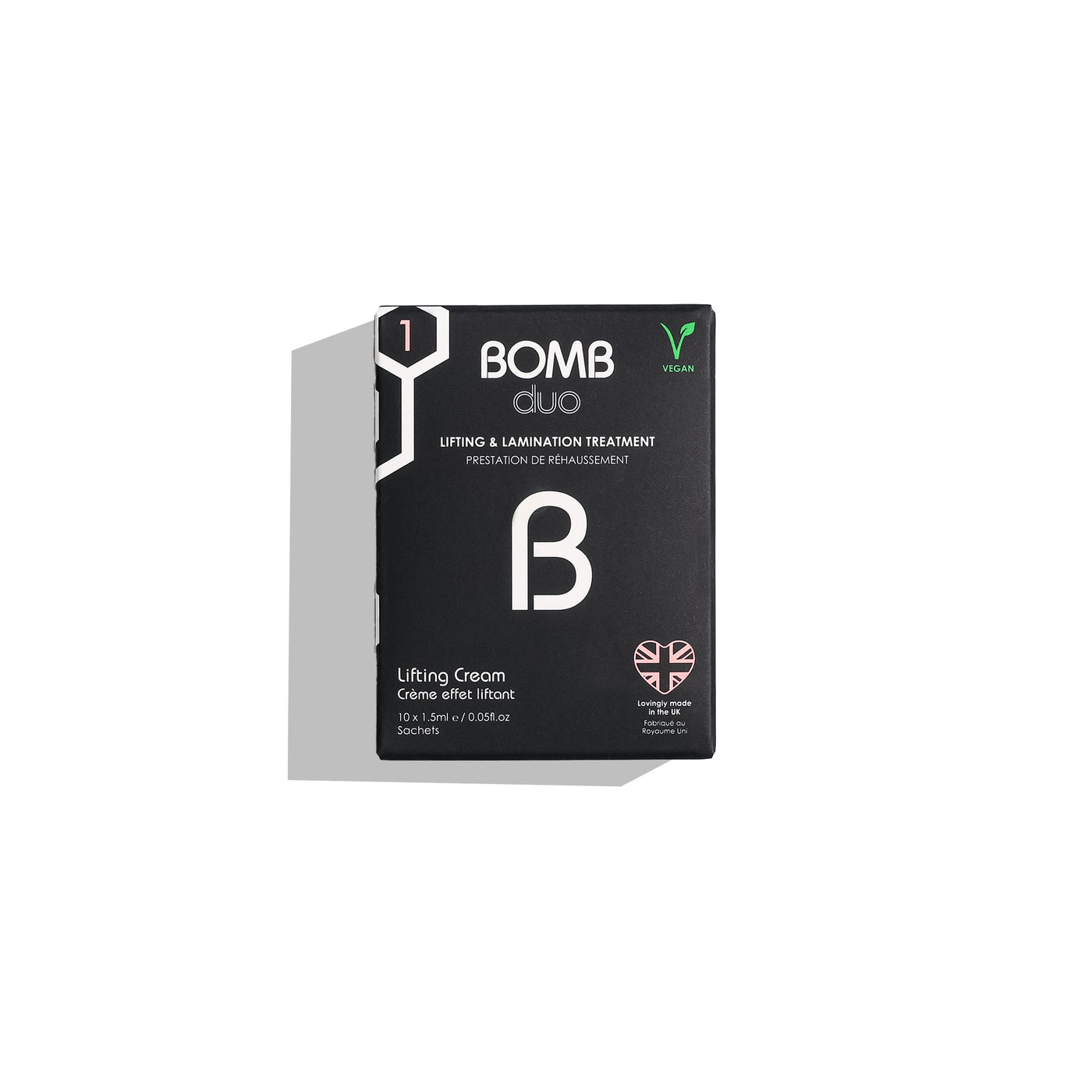
Bomb Duo Step 1
The lamination industry runs on milliliters and minutes. A controlled Step 1 lets you read the hair, not race the timer. Our cysteamine-based formula targets fine and medium brow hair without the high-pH spike of older thioglycolate systems.
Shop Step 1Where the tips lose first
Brow hair grows in slow cycles, so the tip you're touching today is months older than the root. That tip has seen sun, micellar wipes, tinted brow gels, sometimes a previous lamination, occasionally a tweezing scar near the bulb. Its cuticle is already slightly raised. When you brush Step 1 down the full length in a single pass, the reducer slides into those open scales fast, while the fresh root hair barely registers. At minute 8, your tips are already at minute 12. At minute 12, they're past saving.
If she just came in: do nothing today
No second Step 1. No fixing with stronger Step 3. No tinting. Send her home with a recovery routine and a 6-week rebook. Layering more chemistry on freshly over-processed brows turns a recoverable case into a regrowth-only case.
diagnose the damage in 60 seconds
Three checks separate a cosmetic flaw from real structural damage. Run all three before you write off the brows or book a redo. If the lift simply dropped early without any frizz, start with the checklist of causes.
The elasticity test
Lightly mist one hair with water. Pinch it between your thumb and a spoolie tip. Pull gently.
- Healthy: stretches a few millimeters, springs back.
- Mildly over-processed: stretches further than expected, returns slowly or partially.
- Structurally damaged: stretches without resisting, or snaps clean.
A snap or no return contraindicates any new chemistry for 6 to 8 weeks.
Check for these signs of over-processing
- Cottony or rough texture along the length
- Frizz or unwanted waves at the tips
- Hairs snapping under the first spoolie pass
- Matte, lifeless finish instead of natural shine
- Visibly thinner hair diameter at the ends
- Hairs that hold neither their natural shape nor the new lamination curve
The client history check
Three questions decide the recovery timeline:
- How recent was the last lamination? Under 6 weeks ago is a major risk factor.
- Any brow tint or henna in the last 30 days? Tint oxidant compounds the porosity damage.
- Any topical retinoids, accutane history, or chemical peels near the brows? All three thin the hair and raise sensitivity to Step 1.
the four mistakes behind 90% of cases
Timer overruns on the wrong hair type
Fine, sparse, or already-treated hair holds 6 to 8 minutes of Step 1, maximum. Push past 12 minutes and the frizz locks in before Step 2 ever touches the brow. The most common cause of failed lifts: a thick-hair timer used on fine-hair clients.
Flooding the tips
Gravity drags Step 1 down. Capillary action pulls it deeper into porous ends. A loaded brush over the full brow concentrates reducer exactly where the hair is weakest. Apply roots-first, with a 2 to 3 minute gap before sliding product to the tips.
Skipping Step 3
Step 3 isn't an upsell. After Step 1 and Step 2, the cuticle is still half open and the cortex absorbs anything you put on it. That window closes within minutes. Skip Step 3 and the hair sets in its weakened state. Frizz follows within 48 to 72 hours.
Re-laminating too soon
A brow hair runs through anagen, catagen, and telogen in 6 to 8 weeks. Re-laminating early hits a hair still rebuilding from the last session. Minimum: 6 weeks for healthy, 8 weeks for tinted or fine. No exceptions for events.

Bomb Duo Step 3
The repair step that ends the service and protects the result. Loaded with hydrolyzed keratin and amino acids sized to reach the cortex before the cuticle closes. Built for the moment that matters most: 30 seconds after Step 2 rinses off.
Shop Step 3the 8-week recovery roadmap
This protocol assumes moderately over-processed brows. For brows that snap during the elasticity test, the timeline stretches to 10 weeks and the elasticity recheck moves to week 9.
Full chemical pause + baseline
Zero new lamination, tint, or henna. Start daily castor oil at the lash line and along the full brow. Photograph the brows in natural light for a baseline.
Daily protein, twice-weekly moisture
Hydrolyzed keratin serum every evening, brushed through with a clean spoolie. Twice a week, swap for a squalane or castor oil overnight mask. Track frizz daily.
Rebalance and re-evaluate
Mid-protocol elasticity check. If the hair still stretches without returning, extend by 2 weeks. Add a weekly peptide and hyaluronic acid mask. Keep the daily keratin.
Regrowth + cautious return
New growth replaces damaged hair. Final elasticity test at week 8. If clean, schedule lamination with reduced Step 1 time (6 to 8 min max) and mandatory Step 3.
Hydrolyzed keratin isn't a buzzword
Most "keratin" labels on beauty shelves describe a protein that never crosses the cuticle. The fragments are too bulky. They coat the surface, smooth the hair to the touch, and rinse out within a wash or two. Hydrolyzed keratin behaves differently because it's been broken down by enzymes or controlled acid into peptides small enough to migrate through the cuticle and lodge inside the cortex. That's where over-processing left empty space, and that's where repair has to land. Surface keratin still earns its keep as a temporary shield, but the rebuild only happens from inside.
The protein-moisture balance most clinics get wrong
The instinct after over-processing is to dump protein on the brows every day until they feel sturdy again. The result is a hair that looks healthier for a week, then snaps. Protein without water becomes brittle, the same way bone without collagen fractures. The cadence that works alternates: keratin on weeknights, oil-based moisture on weekends, a peptide and hyaluronic acid mask once a week. Six days of rebuild, one day off so the hair doesn't reach protein saturation. The visible difference shows up around week 4, when the new growth starts replacing the damaged tips and the brow brushes through without resistance.
don't let it happen twice
Pre-treat the porous ends before Step 1
A keratin complex or lipid pre-conditioner applied 5 minutes before Step 1 partially saturates the tips. The reducer hits a hair that's already partly full, so it absorbs more slowly and evenly. The same pre-treatment improves how the hair grips the silicone shield, which sharpens the final lift.
Read porosity, not appearance
The hair that looks thickest in the brow chair isn't always the one that can handle the longest Step 1. Porosity decides the protocol, not visual density. High-porosity brows, the ones recently tinted, recently lifted, or chronically dry, drink Step 1 in 6 to 8 minutes and need the cysteamine formula at pH 6.5 to 8. Low-porosity, virgin, coarse brows can stretch to 14 minutes with ammonium thioglycolate at pH 8 to 9.5. The fast read: if you tinted those brows in the last 30 days, treat them as high-porosity regardless of how the hair looks dry on the shield.
Build a real intake form
The intake form is the practitioner's legal and technical shield. It logs: previous lamination date, current and recent tints, retinoid or accutane history, pregnancy, allergic reactions, declared fragility. Without it, every protocol decision relies on the client's memory, which is rarely complete. A two-minute form prevents a six-week recovery.
daily home care for damaged brows
Two ingredients carry most of the recovery work. Both are well-documented, cheap, and easy to layer.
| Ingredient | What it does | How to apply |
|---|---|---|
| Castor oil | Ricinoleic acid feeds the follicle, slows breakage, adds weight to limp regrowth. | One drop on a spoolie, brushed through the brow every night. Patch test first if no prior use. |
| Squalane | Rebuilds the surface lipid film stripped by Step 1. Lighter than castor, no pore-clogging risk. | Morning layer under makeup, or daytime touch-up on dry-feeling tips. |
| Hydrolyzed keratin serum | Penetrates the cortex, refills depleted bond sites, restores elasticity. | Evening application, 6 nights per week. One night off to avoid protein overload. |
| Peptide + hyaluronic acid mask | Deep weekly treatment for moisture and surface plumping. | 10 minutes, once a week. Wipe excess, don't rinse. |

Brow Bomb Moisturising Serum 100ml
The take-home version of in-clinic Step 3. Hydrolyzed keratin, peptides, and lipid replenishers in a 100ml format your clients actually keep on the bathroom counter. The bottle that turns a 60-day protocol into a routine.
Shop The Serumreal questions from the field
Why did my client's brows frizz two days after the lamination?
Can I just redo the lamination to fix it?
How often is safe for repeat clients?
The tips look burnt and curled. Salvageable?
Does Step 3 really matter that much?
What if my client wants color before the protocol ends?
stock the products that actually rebuild
The protocol works with the products you trust. Stack hydrolyzed keratin, a high-quality Step 3, and the lash and brow oils your clients will actually use at home.
Shop Pro Lash & Brow