
thioglycolate or cysteamine: which active for which client
Both reduce the disulfide bonds. Both deliver a clean lift. But one runs faster on resistant hair, smells of rotten eggs, and tolerates a smaller margin of error. The other is odorless, slower, and a forgiving option for fragile or sensitive clients. Stock both, and let the client's hair decide.
two reducing agents. two clients. one chair.
Most US studios still default to thioglycolate for every brow that walks in. That works on healthy, resistant hair — and underperforms on fine, fragile, or previously treated clients who'd thrive on a gentler chemistry. Stocking both actives isn't a luxury; it's how you stop forcing one protocol on every client.
This page is the practical decision guide. For the underlying biochemistry — disulfide bonds, equation of reduction, glass microbeads — see the molecular science guide.
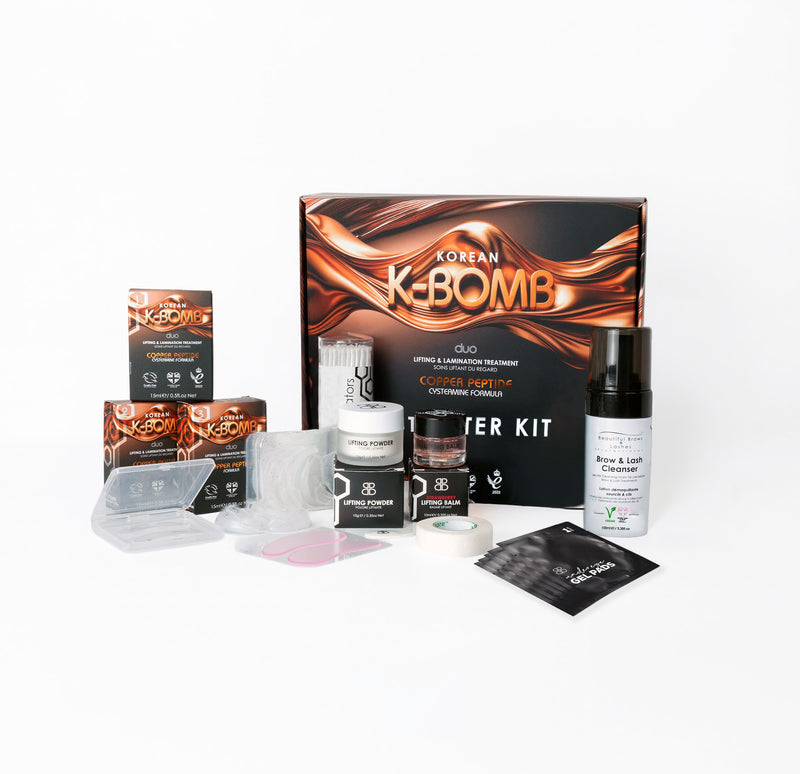
thioglycolate: fast and assertive
Thioglycolate (specifically ethanolamine thioglycolate in the professional version) breaks the hair's disulfide bonds quickly and decisively. Professional products run at an alkaline pH of 9.0 to 9.5. The ethanolamine form is preferred over ammonium thioglycolate because it's more stable, less volatile, and gentler around the eyes — but it's still the assertive option in the toolkit.
Processing time by hair type
| Hair Type | Thioglycolate Pose Time |
|---|---|
| Very fine brows | 3-4 min |
| Fine or previously tinted | 4-5 min |
| Normal, healthy | 5-6 min |
| Thick, coarse, resistant | 6-8 min |
Why estheticians keep it as their default
- Speed: shorter pose times mean a faster service. Eight to ten lamination clients a day is realistic with thioglycolate; cysteamine slows that rotation.
- Grip on resistant hair: coarse, dense, virgin brow hair responds reliably. It's the only active that consistently holds 6 to 8 weeks on thick male brows.
- Predictability: the reaction curve is well-mapped. Estheticians with years of thioglycolate work read the hair confidently.
The trade-offs
- Sulfur odor: the "rotten egg" smell is real from the moment the sachet opens. Ventilation matters. Some clients will comment.
- Smaller error margin: exceed the timing and you're into breakage and weakening territory. The faster reaction is also less forgiving.
- Alkaline stress: pH 9 to 9.5 opens the cuticle aggressively. Healthy hair handles it; fragile hair pays for it.
Always open a window when you open the sachet
The sulfur odor from thioglycolate isn't dangerous in a ventilated room, but it's noticeable and can flag a client's sensitivity if you're not airing things out. A simple cracked window or a small extraction fan during processing solves it. The full timing logic — how diameter, porosity, and room temperature shift the brackets above — sits in the processing time guide.
cysteamine: gentle and forgiving
Cysteamine hydrochloride works differently. Instead of attacking the disulfide bonds with alkaline force, it penetrates progressively at a much gentler pH of 7.5 to 8.5. It's a derivative of cysteine, the amino acid that makes up 10 to 18 percent of human keratin — which is why the reaction reads almost like a treatment soaking into the hair rather than a chemical event on top of it.
Processing time by hair type
| Hair Type | Cysteamine Pose Time |
|---|---|
| Very fine brows | 5-6 min |
| Fine or previously treated | 6-8 min |
| Normal brows | 8-10 min |
Why it's worth the slower clock
- No odor: the spa experience feels clinical and clean. Premium-positioned studios and sensitive clients notice immediately.
- Wider safety margin: the slower reaction is far more forgiving. Beginners building confidence work it without the fear of a 30-second miss.
- Hair-friendly: lower alkaline stress means less cuticle trauma. Fine, color-treated, or compromised hair tolerates it where thioglycolate would push it past the limit.
The trade-offs
- Underwhelming on thick virgin hair: the gentle kinetics struggle to grip coarse, dense brows. Results often start fading at 3 to 4 weeks where thioglycolate would hold 7 or 8.
- Longer chair time: add 3 to 5 minutes per service. Across a day, that's one or two fewer clients on the books.
- Slightly higher product cost: cysteamine systems typically run a premium over thioglycolate sachets.
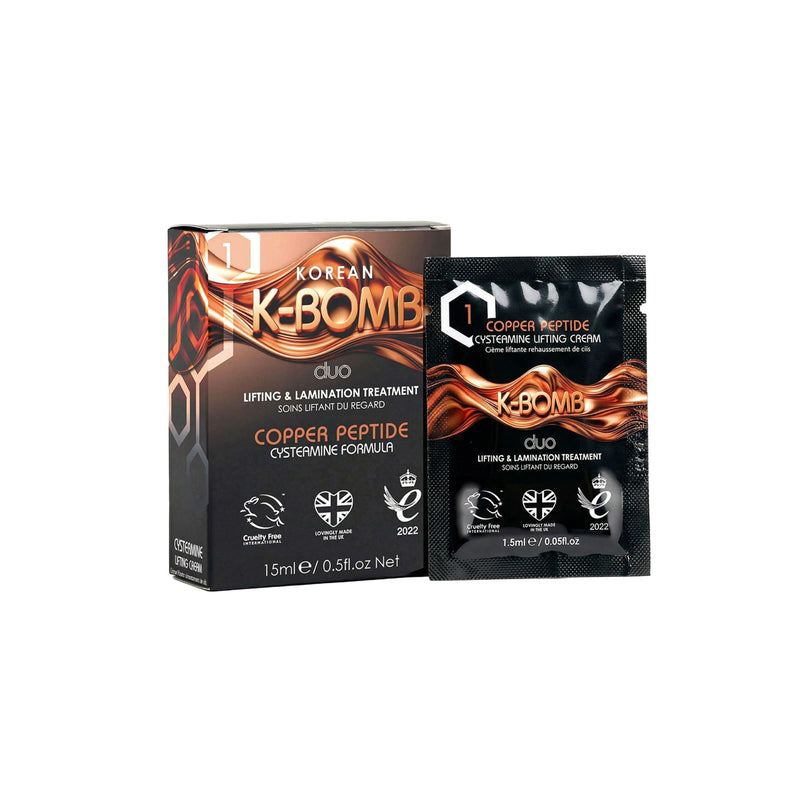
K-Bomb Step 1 Lifting Cream
Cysteamine-based formula for Korean-style lash lifts and brow laminations, built to protect hair during processing. Copper peptide complex plus quercetin and fisetin reduce breakage and add shine. 10 x 1.5 ml sachets, 7 to 15 minute processing, 6 to 8 week hold. Vegan and cruelty-free. Use with the full K-Bomb system.
Shop K-Bomb Step 1the 30-second decision tree
For most clients, the choice is obvious within 30 seconds of the consultation. Two columns, two profiles, one pick.
When speed and grip win
- Thick, coarse, virgin brow hair
- Male clients with dense growth
- Resistant brows that didn't hold a previous gentle lift
- High-volume studios optimizing rotation
- Clients who don't react to the odor
- Long-hold (7-8 week) expectation
When hair health and comfort win
- Fine, sparse, or over-plucked brows
- Previously tinted or chemically treated hair
- Sensitive skin or reactive scalp history
- Clients who can't tolerate the sulfur odor
- Premium spa positioning, slower pacing
- Beginner estheticians building consistency
A thioglycolate allergy doesn't auto-clear cysteamine
Clients who react to thioglycolate sometimes tolerate cysteamine because the molecule is fundamentally different. But that's not a guarantee, and you don't get to skip the patch test on the assumption. Run a separate 48-hour patch with the cysteamine system, even if the client cleared it on thioglycolate, and vice versa. Different chemistry, different test.
the full lamination protocol, 15 steps
The protocol below works identically for thioglycolate and cysteamine — only the Step 1 pose time changes. Use it as a chair-side checklist, not a memory test.
safety, patch tests, contraindications
Both actives demand a patch test. Both have absolute and relative contraindications. The list below applies regardless of which chemistry you're running — switching from thioglycolate to cysteamine doesn't shorten the no-go list.
Absolute contraindications
- Pregnancy and breastfeeding — most US licensed practices delay, especially through the first trimester
- Active skin conditions: eczema, psoriasis, herpes, dermatitis in the brow area
- Eye infections: conjunctivitis, stye, blepharitis (wait 2 weeks after full recovery)
- Recent eye surgery: 6 weeks minimum after LASIK or PRK
- Recent microblading or PMU tattoo: 4 weeks minimum (pigment migration risk)
- Open lesions: cuts, sunburn, abrasions, or any positive patch test
- Accutane (isotretinoin): active or within the last 6 months
Rice-grain dab, 48 to 72 hours, signed consent
Apply a rice-grain-sized drop of Step 1 (whichever active you'll use) on the inner forearm or behind the ear. Leave exposed, do not rinse. Observe for 48 to 72 hours for redness, itching, swelling, or burning. Have the client sign an informed consent form documenting the test, the active, the date, and the result. US licensing requirements vary by state — check your local cosmetology and esthetics board for retention rules, often 5+ years on intake documentation. Re-test every 6 months for regulars and any time you switch them between actives.
After the service: the 48-hour rule
The disulfide bonds keep curing for about two days after Step 2. During that window: zero water on the brow, zero steam, zero oils or makeup, sleep on your back not face-down. From hour 49 onward: gentle brushing morning and evening, optional castor oil 2-3 times a week to nourish. Rebook at the 6 to 8 week mark — earlier and you cumulate stress on hair that hasn't fully recovered.
pricing and margin by active
Both systems land in roughly the same retail bracket because the visible service is identical. The margin differs because chair time and product cost differ. Below is what the math actually looks like for a US studio.
| US Market Tier | Service Price | Material Cost (Sachet) | Gross Margin |
|---|---|---|---|
| Small metros | $65 - $90 | $4 - $7 | 88 - 93% |
| Mid-market cities | $90 - $130 | $4 - $7 | 92 - 95% |
| Major metros (NYC, LA, SF, Miami) | $130 - $190 | $4 - $7 | 94 - 97% |
The hidden margin difference
Sticker price aside, the real difference is volume. A thioglycolate session at 30 minutes lets you run 8 to 10 clients a day. A cysteamine session at 40 to 45 minutes brings that down to 6 to 8. If your studio is throughput-constrained, thioglycolate wins on daily revenue. If your studio is positioned premium and the clients pay accordingly, the slower cysteamine session at a higher price point can net more per chair-hour.
The smart configuration
Most US studios that stock both run thioglycolate as the default and reserve cysteamine for fine-hair clients, premium upsells, and anyone with a sensitivity flag at intake. The cysteamine service is often priced 10 to 20 percent higher with the "gentle premium" framing, which closes the throughput gap without forcing a single chemistry on every brow.
glossary cheat sheet
- Thioglycolate (TGA)
- Reducing agent that breaks disulfide bonds. Used as ethanolamine thioglycolate in professional brow lamination at pH 9-9.5.
- Ethanolamine vs Ammonium Thioglycolate
- The ethanolamine form is more stable, less volatile, and gentler around the eyes than the ammonium form. Standard for brow work.
- Cysteamine Hydrochloride
- Cysteine-derived reducing agent at pH 7.5-8.5. Gentler kinetics, no odor, biocompatible with the hair's own keratin.
- Disulfide Bonds (S-S)
- The strongest bonds in keratin. Both actives target them; only the speed and pH differ.
- Sodium Bromate
- The oxidizing agent in Step 2, reforms the broken S-S bonds in the new shape. Same Step 2 for both actives.
- Bonding Adhesive
- Water-soluble glue that holds the brow direction during processing. Pre-loaded on the spoolie.
- Patch Test
- Mandatory pre-service allergy check, 48-72 hours before. Required separately for each active.
- Cuticle Opening
- The Step 1 chemistry raises the hair's outer scales to let the reducer reach the cortex. More aggressive with thioglycolate, gentler with cysteamine.
real questions from the chair
Thioglycolate or cysteamine — how do I pick on the spot?
Can either active be used during pregnancy?
Why do some brows drop after just 3 or 4 weeks?
If a client reacts to thioglycolate, can I try cysteamine?
Does cysteamine really have no smell?
Can I run thioglycolate Step 1 with a cysteamine Step 2?
Which active makes more money for the studio?
How often can I re-laminate a client?
match the chemistry to the client, not the other way around
The thioglycolate BOMB Duo for speed and grip. The cysteamine K-Bomb for fragile hair and sensitive clients. Stock both, run them where they each belong, and stop forcing one protocol on every brow.
Shop The Lamination Systems