
brow lamination timing, the minutes that decide the result
Three minutes too long and the brow frizzes at the tips. Two minutes too short and the shape collapses by week one. Step 1 timing is the single variable that separates a $200 brow service from a recovery appointment. Here's the chart.
timing isn't a recipe. it's a read.
Every published lamination timer is a starting estimate. The real number lives in the hair you're touching right now: its diameter, its tint history, its porosity, the temperature of your treatment room, the humidity outside. A 6-minute Step 1 on coarse virgin hair in a 78°F Phoenix studio is not the same protocol as a 6-minute Step 1 on the same client in a 65°F New England winter.
The guide below gives you the bracket. Your spoolie check at the half-time mark gives you the final number.

read the hair before you set the timer
Brow hair diameter on adult clients runs roughly between 50 and 120 microns. That spread is enormous in chemistry terms: fine hair at 60 microns absorbs Step 1 about 40 percent faster than coarse hair at 110 microns because the cuticle layers are fewer and the cortex is closer to the surface. The same timer applied to both types produces two different services.
Three checks let you classify the brow in under 30 seconds, before any cream touches the skin.
Diameter check with tweezers
ToolPinch a single hair near the root and roll it between the prongs. If you barely feel resistance, the hair is fine (50-70 microns). Slight friction means medium (70-90). Clear gritty pushback means coarse (90-120).
Shine and cuticle read
ToolGlossy, reflective brow hair signals tightly closed cuticles and low porosity. The hair will resist Step 1 and need the upper bracket of the timing window. Matte, lifeless hair means the cuticle is already open: shorten Step 1 by 60 to 90 seconds.
Stretch test on a single hair
ToolWet one hair, pinch it between thumb and spoolie tip, pull gently. Springs back fast: healthy, full Step 1 timing. Stretches and returns slowly: porous, treat as fine. Snaps: skip the service, schedule recovery.
Hair read happens before brow mapping, not after
Mapping decides the shape. The hair read decides the chemistry. If you map first and read after, you've already committed to a design before you know what the hair can tolerate. Read first, design second. We cover the mapping logic in our brow mapping and architecture guide.
fine brows: 3 to 5 minutes of step 1, no more
Fine brow hair (under 70 microns), over-plucked brows, tinted brows, and previously laminated brows all share one trait: their cuticle is already partly open before you start. Step 1 penetrates fast, the cortex softens fast, and over-processing happens fast.
The fine-brow timing window
- 3 minutes: very fine, sparse, or over-plucked brows. Use only on hair that visibly lacks density.
- 4 minutes: tinted brows, recently treated brows, mature brows (post-45).
- 5 minutes (hard ceiling): fine but virgin and healthy brows.
Application technique for fine hair
Apply Step 1 in a translucent layer at the root only when the goal is vertical lift on healthy fine hair. For rebellious-but-fine structures, coat the full length, but lighter than you would on coarse hair. Brush in the final direction with a clean spoolie pre-loaded with bonding adhesive. The spoolie does the shaping; the cream does the chemistry.
At the 2-minute 30 mark, lift the corner of any film cover and check one hair with tweezers. A correctly processing fine hair bends 90 degrees without resistance and returns slowly. If it bends limp, rinse immediately and shorten next session by 30 seconds. If it still resists, give it 30 more seconds and recheck.
Step 2 on fine hair: 5 minutes, fixed
Hydrogen peroxide (3 percent) closes the bonds in the new position. Five minutes on fine hair is enough to set the structure for the full 5 to 7 week run. Pushing to 6 minutes adds nothing measurable; pushing to 7 starts drying the cortex. Apply where the Step 1 was deposited, not on the skin.
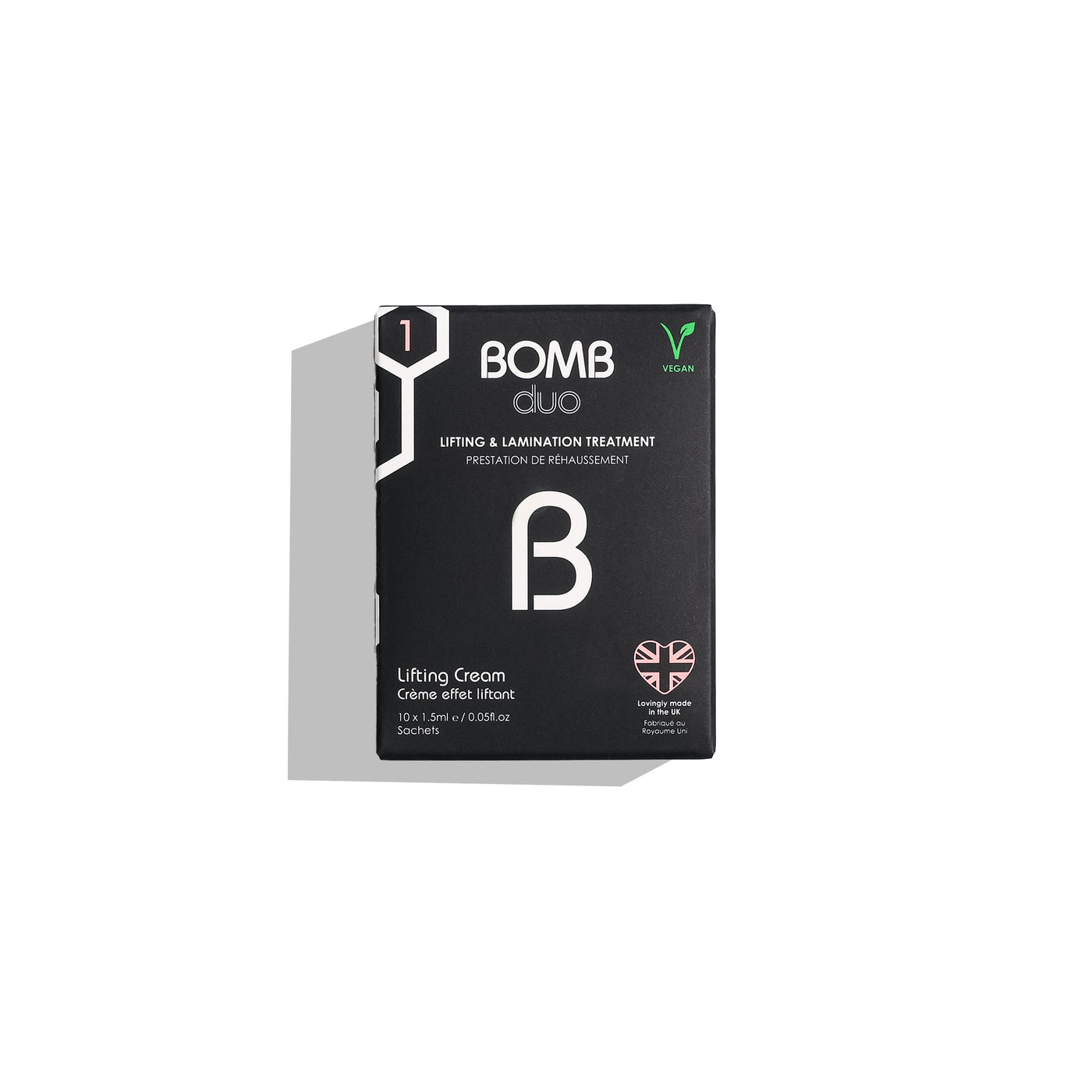
BOMB Duo Step 1
Cysteamine-based reducer calibrated for fine to medium brow hair. Gentler pH (6.5 to 8) than ammonium thioglycolate systems, which extends the safe timing window without compromising lift quality. The default Step 1 for tinted or previously treated brows.
Shop Step 1coarse brows: 6 to 7 minutes, and the ceiling is real
Dense, virgin, melanin-rich brow hair contains more native keratin and presents overlapping cuticle layers that slow chemical penetration. Step 1 needs more time to reach the cortex, and the timing bracket lives in the 6-to-7 minute range. The ceiling is 7 minutes, full stop. Past that, even on the strongest hair, the cortex starts to lose keratin it can't replace, and the tips dry within 48 hours.
The coarse-brow timing window
- 6 minutes: dense and healthy brows, virgin or rarely treated.
- 6 minutes 30: very dense brows with natural spiral, high melanin pigmentation.
- 7 minutes (absolute ceiling): the most resistant structures, only on confirmed-virgin hair.
Application technique for coarse hair
Coarse brows need full-length coverage from base to tip, in an opaque layer that covers each strand entirely. Massage the Step 1 sachet gently before opening to homogenize the viscosity. Cover with plastic wrap or shield to create a localized heat chamber that accelerates the reaction roughly 15 percent without raising the room temperature.
At the 5-minute mark, check malleability. A coarse hair processing correctly bends 90 degrees and holds the new direction when you remove the tweezers. If it still springs back rigidly, give it 60 to 90 more seconds. If it bends without any resistance at all, the hair has crossed into over-processing and you should rinse now.
Step 2 on coarse hair: 6 minutes
Six minutes of hydrogen peroxide closes the bonds on coarse hair. The extra minute over fine hair compensates for the slower oxidation rate through dense cuticle layers. No film cover for Step 2, regardless of hair type. Visual access is more important than reaction speed at this stage.
the four variables that move every timing by 60 seconds
The hair type sets the baseline. The four variables below adjust the baseline by 30 to 90 seconds in either direction. A coarse brow read of 6 minutes can become a 5-minute treatment in Miami summer or a 7-minute treatment in Denver winter. Same client, same hair, different protocol.
How treatment room conditions shift Step 1 timing
Ambient temperature
Cysteamine and ammonium thioglycolate both react faster at higher temperatures. A treatment room kept at 78-82°F (think Phoenix or Miami in season) accelerates the chemistry by roughly 15 percent. Reduce Step 1 by 30 seconds. A cooler room below 68°F (a Vermont studio in January, an over-air-conditioned California chain) slows the reaction noticeably: add 60 seconds to the coarse-hair bracket, 30 to the fine bracket.
Humidity
Dry air below 40 percent relative humidity dehydrates the Step 1 layer on the brow before it finishes its job. Add 45 seconds in Denver, Phoenix, Las Vegas winters. Humid air above 70 percent boosts penetration: subtract 30 seconds in Miami summers, Houston, New Orleans.
Tint or color history
Brows tinted in the 14 days before the lamination have partially open cuticles, regardless of hair diameter. Subtract 60 seconds from Step 1, no matter what your tweezer test said. If a hybrid stain is planned same-session post-lamination, run it 60 to 90 seconds maximum because the open cuticle pulls pigment aggressively.
Topical actives and medication history
Clients on topical retinoids (tretinoin, retinol over 0.3 percent), on AHA or BHA daily, or with accutane history in the past 12 months present hypersensitive skin and weakened brow hair. Subtract 120 seconds from each step and apply Step 3 generously. If accutane is current or within 6 months, postpone the service.
three failure modes and how to recover
Under-processed: the brow won't hold
What you see: the brow brushes up at the end of the service but drops back to its original direction within 48 to 72 hours.
What happened: Step 1 was pulled too early. Cuticles barely opened, disulfide bonds reset to their original positions within hours of Step 2 closing.
How to fix: do not retreat the same day. Schedule a corrective appointment 48 to 72 hours out, run Step 1 with 60 additional seconds, and stay close to the half-time check.
Over-processed: frizz, dryness, brittle tips
What you see: within 24 to 48 hours, the brow looks cottony, the tips kink, individual hairs snap at the spoolie pass.
What happened: Step 1 ran past the ceiling for the hair type, or the room ran too hot, or both. The cortex lost more keratin than the follicle can rebuild in one cycle.
How to fix: no new chemistry for 8 weeks minimum. Daily castor oil at the lash line and along the brow shape. Weekly peptide and hyaluronic acid mask. New growth replaces damaged hair over 6 to 8 weeks.
Skin irritation or burning sensation
What you see: redness, stinging, or itching during application, often within the first 3 minutes.
What happened: Step 1 leaked onto skin, or the client has unacknowledged sensitivity, or the patch test was skipped.
How to fix: rinse immediately with lukewarm water, apply a saline-soaked compress for 10 minutes, document the reaction on the intake form. Refer to a dermatologist if redness persists beyond 24 hours. Add this client to a no-lamination list unless cleared by a dermatologist.
the master timing chart
The bracket below is the working reference. Print it, laminate it, tape it inside your supply cabinet. Every adjustment in the variables section above stacks on these baselines.
| Hair Profile | Step 1 (Reducer) | Step 2 (Oxidizer) | Step 3 (Repair) |
|---|---|---|---|
| Fine, sparse, over-plucked | 3 min | 5 min | Generous |
| Fine, tinted, or mature (45+) | 4 min | 5 min | Generous |
| Fine, virgin, healthy | 5 min | 5 min | Standard |
| Medium, healthy | 5-6 min | 5-6 min | Standard |
| Coarse, healthy, virgin | 6 min | 6 min | Standard |
| Very dense, spiral, melanin-rich | 6.5-7 min | 6 min | Standard |
| Male brow (coarse, healthy) | 6-7 min | 6 min | Standard |
Where most US salon clients land on the timing scale

BOMB Duo Step 3
Hydrolyzed keratin and amino acids sized to enter the cortex during the 90-second window after Step 2 rinses off. The repair stage that turns a 4-week result into a 7-week result. Apply generously on every fine, tinted, or over-plucked brow, regardless of Step 1 timing.
Shop Step 3contraindications and the patch test
Timing matters only if the chemistry is allowed on the brow at all. Five conditions are absolute no-go's. Five more are relative and require protocol modification.
Absolute contraindications
- Confirmed allergy to thioglycolate or cysteamine via patch test or prior reaction
- Active eczema or psoriasis in the brow area
- Active conjunctivitis or any eye infection
- Open wounds or recent piercings near the arch
- Active or recent (under 6 months) accutane treatment
Relative contraindications (modify protocol or delay)
- Pregnancy and breastfeeding: FDA does not prohibit, but US licensed practices typically delay through first trimester. Hormonal shifts also alter the lamination result.
- Recent LASIK or eye surgery: wait 6 weeks minimum
- Recent chemical peel or microneedling: wait 14 days minimum
- Daily topical retinoids: reduce each step by 90 seconds, apply Step 3 generously
- Very fine sparse brows: not a hard no, but treat at the 3-minute Step 1 ceiling
48 hours minimum, no shortcuts, document on the intake form
Cysteamine and ammonium thioglycolate cause allergic contact dermatitis in 2 to 5 percent of the population. Apply a drop of Step 1 behind the ear or inside the elbow 48 to 72 hours before the session. State cosmetology boards in most US jurisdictions treat a skipped patch test as a documented exposure to liability claims. Log the test, the date, and the result in the client's intake file.
glossary cheat sheet
- Cysteamine
- Reducing agent in the Step 1 of gentler lamination systems, pH 6.5 to 8. The US-market default for fine, tinted, or previously treated brows.
- Ammonium Thioglycolate
- Reducing agent in higher-strength Step 1 formulations, pH 8 to 9.5. Reserved for coarse, virgin, resistant brow hair.
- Hydrogen Peroxide (3%)
- Oxidizing agent in Step 2. Closes the disulfide bonds in the new direction set by the spoolie pass.
- Cuticle
- Outer protective layer of the brow hair. Determines how fast Step 1 penetrates. Opens with tinting, heat, and chemical processing.
- Cortex
- Inner structural layer of the hair, where keratin and disulfide bonds live. The target of every Step 1 reaction.
- Disulfide Bonds
- Chemical bridges between cysteine amino acids that decide whether the hair stays in the position you brushed it to.
- Bonding Adhesive
- Water-soluble glue applied before Step 1 to hold the brow shape during the chemical process. Pre-loaded on the spoolie.
- Patch Test
- Mandatory pre-service allergy check. Drop of Step 1 applied behind the ear or inside the elbow 48 hours before lamination.
- Hydrolyzed Keratin
- Keratin broken into low-molecular-weight peptides small enough to enter the cortex during the open-cuticle window after Step 2.
real questions from the chair
Can I run brow lamination without plastic wrap?
How long does a US salon lamination actually last?
What's the absolute ceiling on Step 1 timing?
Can damaged brows recover after over-processing?
Should I tint after lamination or in a separate session?
Can I laminate the week before a wedding or event?
Are timings different for male brow clients?
before you book your first lamination
Two more pieces of the puzzle live next door. The kit you stock decides which formula and which pH you're working with. The mapping you draw before Step 1 decides whether your timing serves the right shape.
get the timing right with the system built for it
The BOMB Duo lamination system is calibrated for the timing ranges in this guide. Cysteamine Step 1, peroxide Step 2, hydrolyzed keratin Step 3. Stock the full lineup and let the chemistry do its job.
Shop The Lamination Toolkit