
brow lamination, the full playbook for US licensed estheticians
Brushed-up shape, denser-looking arch, no makeup needed. Brow lamination is the highest-margin add-on in the US brow chair right now, and the only one with a five-week revenue runway between sessions. Here's the science, the pricing, and the protocol.
not a tattoo. not a tint. a structural reset.
Brow lamination chemically softens the brow hair, brushes it into a new direction, and locks it there. The arch reads fuller, the shape reads sharper, and the client wakes up with brushed-up brows for the next five to seven weeks. No needles, no pigment, no skin trauma.
The service slots into a brow chair you already run. Forty-five minutes, two solutions, one shaping pass with a spoolie. Adds $75 to $200 per appointment depending on your market, and pulls a higher repeat rate than tinting or shaping alone because the result is dramatic enough that clients book in advance.
brow lamination, before and after
The shift isn't subtle. Sparse arches read full, kinked hairs read disciplined, and the brow tail lifts into a shape that mascara and pencil can't fake. Two client transformations before you book your first paying appointment.


Shoot in natural daylight, side-by-side, same angle
Before/after content drives more bookings than any other format on TikTok and Instagram. Same lighting, same lens distance, no filter with a woman...or a man ! Two seconds of brushed-up brow movement on camera converts better than five before/after stills stacked together.
the chemistry in plain English
The brow hair is held in shape by two kinds of internal bonds. The strong ones, disulfide bridges between cysteine amino acids, decide whether the hair lies flat, curls, or fights you when you brush it. To redirect a brow that wants to grow sideways, you have to temporarily break those bonds, push the hair into a new shape, then close them in the new position.
Step 1: the reducer (Lifting Cream)
The first solution is a reducing agent. On the US market, two options dominate. Cysteamine at pH 6.5 to 8 is the gentler choice and the default for fine, tinted, or previously treated brows. Ammonium thioglycolate at pH 8 to 9.5 works faster and harder, and is reserved for coarse, virgin, resistant brow hair. Both open the disulfide bonds, both soften the hair to the point where a spoolie can redirect every strand.
Step 2: the oxidizer (Neutralizing Lotion)
Once the hair is brushed into shape and held there by the silicone shield (or a film of bonding glue), the second solution closes the bonds in the new position. The active is hydrogen peroxide at low concentration, typically 3 percent. Two to five minutes on, no longer, no shorter. Pull too early and the shape collapses overnight. Leave too long and the cortex dries out, which is the start of frizz at the tips.
Step 3: the recovery treatment
After Step 2 rinses off, the cuticle is still slightly open and the cortex is in a window of maximum absorption that closes within minutes. This is the only moment of the entire service when low-molecular-weight hydrolyzed keratin can actually reach the cortex and fill the gaps that the chemistry created. Step 3 isn't a finishing flourish. It is the structural conclusion of the protocol.
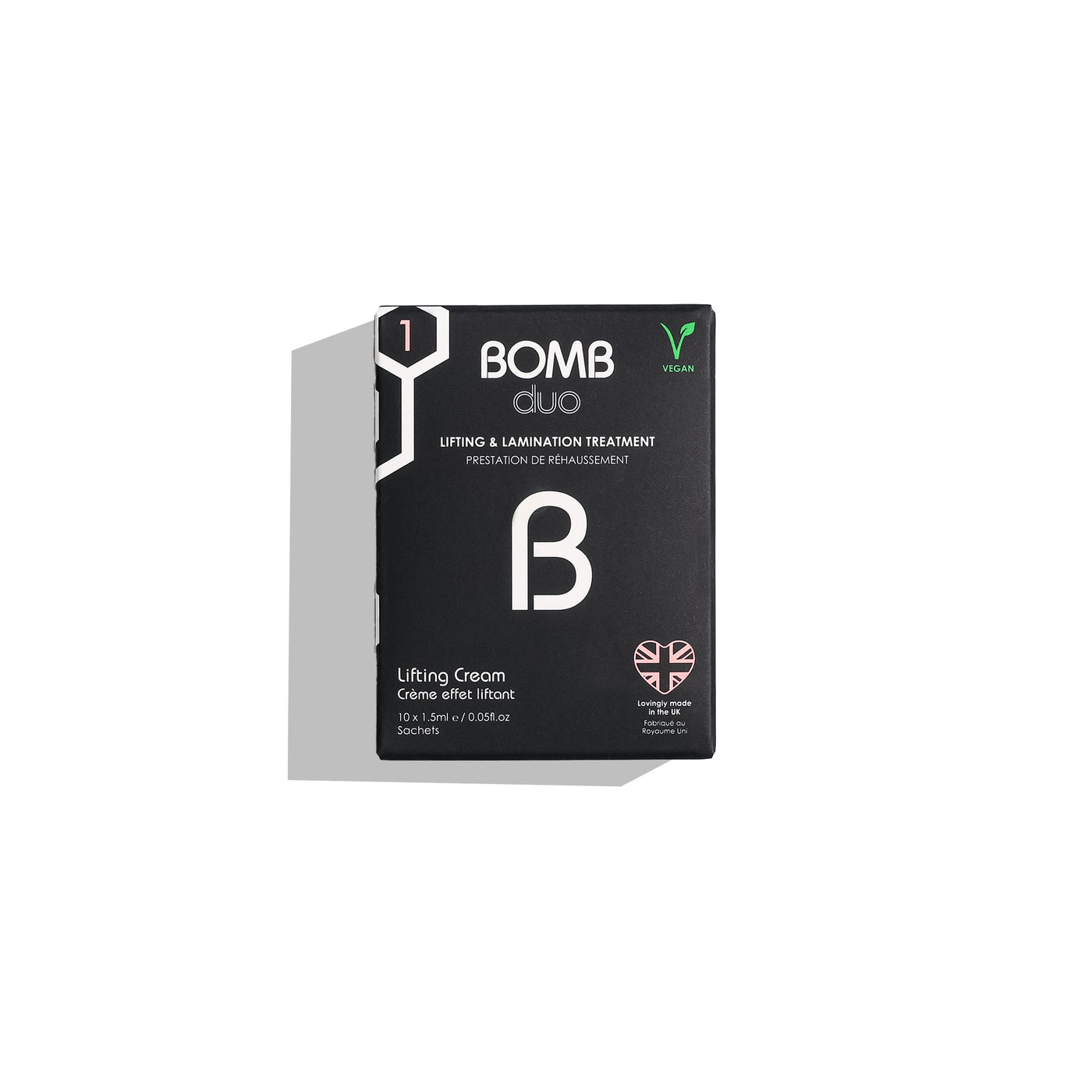
BOMB Duo — Steps 1, 2, 3
The complete three-step lamination system used in over 2,000 US brow chairs. Cysteamine-based Step 1 calibrated for fine to medium hair, peroxide Step 2 with built-in viscosity for clean application, hydrolyzed keratin Step 3 for the closing repair window.
Shop The Full Duobrow lamination vs lash lift
The two services share a chemistry family and a chair time, but they solve different problems and they sell at different prices. Mixing them up in client conversations costs bookings; clients ask for one and get sold on the other.
| Criterion | Brow Lamination | Lash Lift |
|---|---|---|
| Goal | Redirect & flatten brow hair into a shape | Curl natural lashes upward from the root |
| Duration of result | 5 to 7 weeks | 6 to 10 weeks |
| Step 1 time | 4 to 7 minutes (hair-dependent) | 6 to 12 minutes (hair-dependent) |
| Formula viscosity | Higher, holds on brow shape | Lower, wraps around silicone shield |
| Key tool | Spoolie + plastic wrap or shield | Curved silicone shield + glue |
| Average US salon price | $75 to $200 | $60 to $150 |
| Best add-on | Brow tint same session | Lash tint same session |
Duration, price, and rebook rate across the brow chair
the five-step in-chair workflow
Total chair time: 40 to 50 minutes. Service price: $75 to $200 depending on your market. Materials cost: under $5 per client. The protocol below assumes a BOMB Duo system; pH and timers shift slightly with other reducers. Timing by hair type is broken down in the Brow Bomb processing time guide.
Cleanse + map + bond
Remove all oil with a brow-specific cleanser. Map the brow shape with a pencil. Apply bonding adhesive and brush the hair into the chosen direction with a clean spoolie.
Apply Step 1, time it
Fine or tinted brows: 4 to 5 minutes. Medium: 5 to 6 minutes. Coarse: 6 to 7 minutes. Cover with plastic wrap or shield. Remove dry with a microfiber cloth, never water.
Apply Step 2, no cover
Brush Step 2 over the brow. No plastic wrap. Time: 5 minutes for fine hair, 6 for coarse. Remove with a damp cotton pad in clean upward motions.
Tint while the cuticle is open
If tinting same session: mix tint with developer, apply on still-damp brows, leave on 60 to 90 seconds max. The post-lamination cuticle pulls pigment fast.
Step 3 + aftercare card
Apply Step 3 generously, work it in with the spoolie for 30 seconds. Do not rinse. Hand client the aftercare card with the 48-hour no-water rule.
the profit math behind every appointment
Brow lamination is the highest-margin service on most US brow menus. Material cost runs $3 to $5 per client even with premium-tier product. At an average ticket of $140 in mid-market metros, the gross margin sits north of 96 percent on materials alone. Add a $30 brow tint upgrade and a $25 retail aftercare bottle and the average revenue per chair climbs above $190.
Where every dollar goes on a $140 service
How to push the ticket above $200
Three add-ons account for almost all the lift between a $140 lamination and a $200-plus appointment. None of them adds more than 10 minutes of chair time.
- Brow tint same session: +$25 to $40, two extra minutes of timer. Pigment uptake is exceptional on freshly laminated hair, so a single coat gets you the result of two.
- Brow shape and clean-up: +$20 to $35. The new shape exposes stray hairs that weren't visible before. Wax, tweeze, finish.
- Retail aftercare bottle: +$22 to $35. The take-home Step 3 serum or InTOXXification keeps the result tight and turns the client into a refill repeat.

Brow Bomb Moisturising Serum 100ml
The retail version of in-chair Step 3. Hydrolyzed keratin, peptides, lipid replenishers in a 100ml bottle clients keep on the bathroom counter. Average attach rate in US salons: 38 percent. Repeat purchase cycle: 8 weeks.
Shop The Serumsafety, contraindications, and the patch test
Brow lamination is a low-risk service when intake is run properly. The two failure modes that account for almost every documented adverse reaction are skipped patch tests and untreated dermatological conditions in the brow area. Both are preventable in under five minutes.
Absolute contraindications
- Active eczema or psoriasis in or near the brow, even mild patches
- Conjunctivitis or any active eye infection, bacterial or viral
- Positive patch test: redness, itching, raised skin within 48 hours of patch application
- Open wounds: recent cuts, scratches, healing piercings near the arch
- Active herpes simplex outbreak in the face area, risk of viral spread
Relative contraindications (delay or modify)
- Pregnancy and breastfeeding: not contraindicated by FDA, but precautionary delay is standard in most US licensed practices. Hormonal shifts also alter the chemistry result.
- Recent eye surgery (LASIK, blepharoplasty, brow lift): wait 6 weeks minimum.
- Recent chemical peels or microneedling in the brow area: wait 14 days minimum.
- Topical retinoids or accutane history: reduce Step 1 timing by 30 percent, mandatory Step 3.
- Very fine or sparse brows: not a hard no, but treat as high-porosity and reduce Step 1 to 4 minutes maximum.
48 hours, behind the ear or inner elbow, no exceptions
Cysteamine and ammonium thioglycolate cause allergic reactions in roughly 2 to 5 percent of the population. The patch test is the only way to identify those clients before the chemistry hits the brow. State boards in most US jurisdictions treat a skipped patch test as a malpractice exposure. Document the test on the intake form with date and result.
the 48-hour aftercare window
The shape isn't fully set when the client leaves the chair. Disulfide bonds finish reforming over the following 48 hours, and any chemistry, moisture, or heat that enters the brow during that window weakens the bond pattern. Failure to follow aftercare cuts the result duration by half.
The four no's for 48 hours
- No water on the brow: no shower spray, no swimming, no face wash above the cheekbones.
- No steam: no sauna, no steam room, no facial steaming, no boiling-pot cooking close to the face.
- No oils or rich creams on the brow area, including moisturizers that drift up from the cheeks.
- No makeup on the brow, no powder, pencil, gel, or pomade. Below the brow is fine.
From day 3 onward: the maintenance routine
Brush the brow upward every morning with a clean spoolie to reset the shape. Apply a take-home Step 3 serum or a brow growth oil every evening to feed the cuticle. The clients who do both routines reliably get 7 weeks of result. The ones who skip both get 4.

BOMB Duo Step 3
The repair step that closes every service. Hydrolyzed keratin and amino acids sized to reach the cortex during the 90-second window after Step 2 rinses off. Built for the moment that decides whether the result holds 4 weeks or 7.
Shop Step 3real questions from the chair
How long does brow lamination actually last in the US climate?
Can I laminate fine, sparse brows?
Does it work on men's brows?
Can I tint the brows in the same appointment?
What's the difference vs microblading?
How soon can a client re-laminate?
What licensing do I need to perform brow lamination in the US?
glossary cheat sheet
- Brow Lamination
- Chemical service that softens, redirects, and re-sets brow hair into a new shape, typically brushed upward. Lasts 5 to 7 weeks.
- Cysteamine
- Reducing agent used in Step 1 of gentler lamination systems, pH 6.5 to 8. Preferred for fine, tinted, or fragile brows.
- Ammonium Thioglycolate
- Reducing agent used in Step 1 of higher-strength lamination systems, pH 8 to 9.5. Used on coarse, virgin, resistant hair.
- Disulfide Bonds
- Chemical bridges between cysteine amino acids that hold the hair's structural shape. Lamination temporarily breaks and reforms them.
- Hydrolyzed Keratin
- Keratin broken down into low-molecular-weight peptides small enough to enter the hair cortex and rebuild it from the inside.
- Bonding Adhesive
- Water-soluble glue applied before Step 1 to hold brow hairs in the chosen shape during the chemical process.
- Patch Test
- Mandatory skin test applied 48 hours before service to detect allergic sensitivity to the Step 1 reducer.
- Step 3 Repair
- Hydrolyzed keratin treatment applied in the 90-second post-Step-2 window when the cuticle is still open and absorbs deeply.
- Spoolie
- Disposable mascara-style brush used to shape brows during the protocol and at home during aftercare.
everything you need to launch lamination this week
The BOMB Duo full system, retail aftercare for client take-home, training resources, and downloadable consent forms. Sourced from the most-used US brow chair toolkit.
Shop brow lam kits