
the molecular science of brow lamination
Every lift is a controlled chemical event. You break the disulfide bonds that hold the hair's shape, redirect the fiber, then rebuild the bonds in the new position. Understand the chemistry and the timing stops being guesswork — it becomes a reaction you control.
the hair holds its shape with three bonds
Brow hair is keratin — a fibrous protein built from polypeptide chains. Those chains are held in place by three kinds of bonds, and only one of them decides the hair's permanent direction. Break that one and you can reshape the brow. Leave it intact and the hair springs back the moment it dries.
Lamination targets the strongest of the three: the disulfide bond. Everything else in the protocol — the pH, the timing, the neutralizer — exists to break and rebuild that single covalent link safely.

the three bonds, ranked by strength
Knowing which bond does what tells you why water alone never reshapes a brow, why a humid day can soften a fresh lift, and why only a reducing agent achieves a permanent change. The hair's shape memory lives almost entirely in the strongest bond.
Hydrogen bonds
The weakest of the three. Broken by plain water, which is why a wet brow brushes into shape and a dry one snaps back. They reform as the hair dries. No permanence.
Salt bonds (ionic)
Ionic links sensitive to pH. They shift when the chemistry changes the acidity around the hair, but on their own they don't hold a reshaped brow. Part of why pH matters in every step.
Disulfide bonds (S-S)
Covalent sulfur-to-sulfur links between cysteine residues. The strongest bond and the one that dictates the hair's rigidity and direction. Reshaping a brow is impossible without breaking these inside the cortex.
To reach the disulfide bonds, the reducing agent has to cross the cuticle — the hair's outer scale layer — and enter the cortex where the bonds live. That's why the first thing every Step 1 does is raise the cuticle scales: no entry, no reaction.
the reduction reaction, in one equation
Brow lamination is a reduction-oxidation cycle. Step 1 reduces (breaks) the disulfide bonds. Step 2 oxidizes (rebuilds) them in the new position. The reduction half of that cycle is what makes the hair malleable, and it follows a single, predictable equation.
In plain terms: the reducing agent (R-SH) donates hydrogen to the hair's disulfide bond (K-S-S-K), splitting it into two free thiol groups (K-SH). The hair goes from a rigid lattice to a soft, mouldable matrix that accepts whatever direction your spoolie sets. Once the shape is held, Step 2 reverses the reaction and locks the new architecture.
Which reducing agent you use changes everything downstream — the pH, the speed, the gentleness, the timing window. That's the real difference between the two BBL systems below.
the classic thioglycolate system
The original BOMB Duo runs on ethanolamine thioglycolate as its reducing agent, at an alkaline pH of 9.0 to 9.5. The ethanolamine form was chosen over ammonium thioglycolate deliberately: its reaction kinetics are slower and more controllable, which matters in the delicate periorbital area where ammonium thioglycolate is considered too aggressive.
Lifting cream, pH 9-9.5
Ethanolamine thioglycolate breaks the S-S bonds. Urea acts as a penetration enhancer. Cocoa seed butter forms a lipid film against dehydration; biotin and niacinamide reinforce the fiber; hydrolyzed rice, wheat, and soy proteins feed amino acids back in.
Neutralizing cream, pH 6-6.5
Sodium bromate rebuilds the disulfide bonds in the new shape through oxidation. Carries glass microbeads (more on those below), plus panthenol and hyaluronic acid for multi-layer rehydration.
Moisturizing serum, leave-in
Seals the cuticle and restores baseline. Aloe vera soothes, marshmallow extract detangles, arnica montana calms inflammation, horsetail extract remineralizes the fiber.
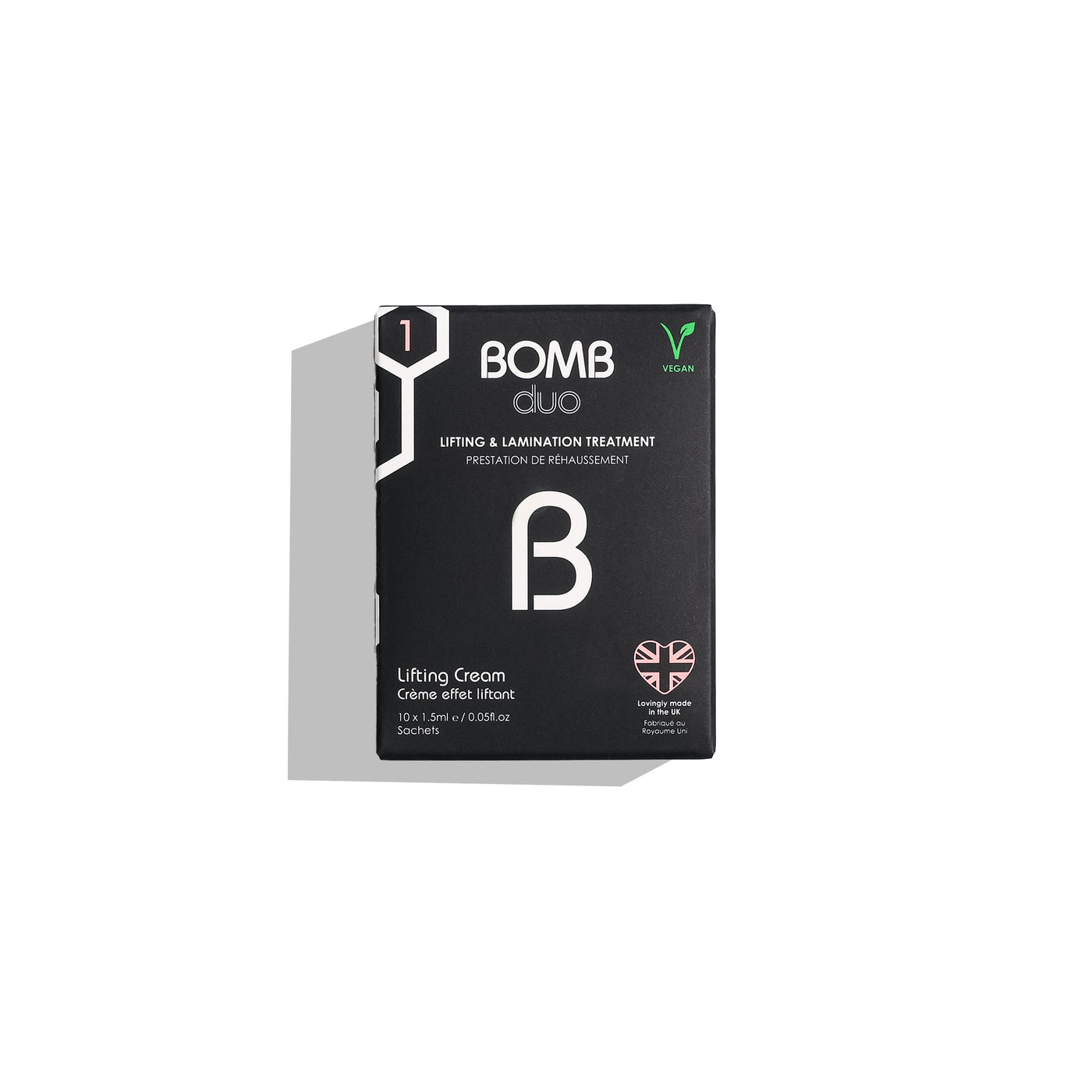
BOMB Duo Sample Pack
Try the full three-step classic system before you commit. Step 1 lifts, Step 2 neutralizes with the glass-microbead finish, and the Step 3 moisturizing stage removes the hair from the shield and protects fiber health. Free sample pack — see the brow lamination kit guide for the full pro setup.
Get The Sample Packk-bomb: the cysteamine alternative
K-Bomb swaps the thioglycolate for cysteamine hydrochloride — and that single substitution changes the entire safety and comfort profile. Cysteamine is a derivative of cysteine, the very amino acid that makes up 10 to 18 percent of human keratin. Because the reducing agent so closely resembles the hair's own building block, it remodels the fiber biocompatibly, without the strong alkaline stress of the classic system.
The headline number is the pH. K-Bomb runs at 7.5 to 8.5, meaningfully gentler than the 9.0 to 9.5 of the thioglycolate system. Less alkaline stress means less cuticle trauma, which is the whole point of the "Korean-style" approach: results without the structural cost.
What the cysteamine formula adds
- Copper peptide complex: stimulates collagen production and supports the anagen (growth) phase by increasing blood flow around the follicle.
- Antioxidant flavonoids: quercetin and fisetin shield the follicle from environmental damage and neutralize oxidative stress during processing.
- Gentler kinetics: the trade-off is time. Where the classic system runs short, K-Bomb processes 7 to 15 minutes depending on hair type, because the lower pH works more slowly.
Classic for speed and grip, K-Bomb for fragile or compromised hair
Reach for the classic thioglycolate system on healthy, resistant brows where you want fast, reliable grip. Reach for K-Bomb on fine, previously treated, fragile, or color-compromised hair, on clients who report sensitivity, and any time hair health is the priority over processing speed. The lower pH and the copper-peptide support make it the protective choice.
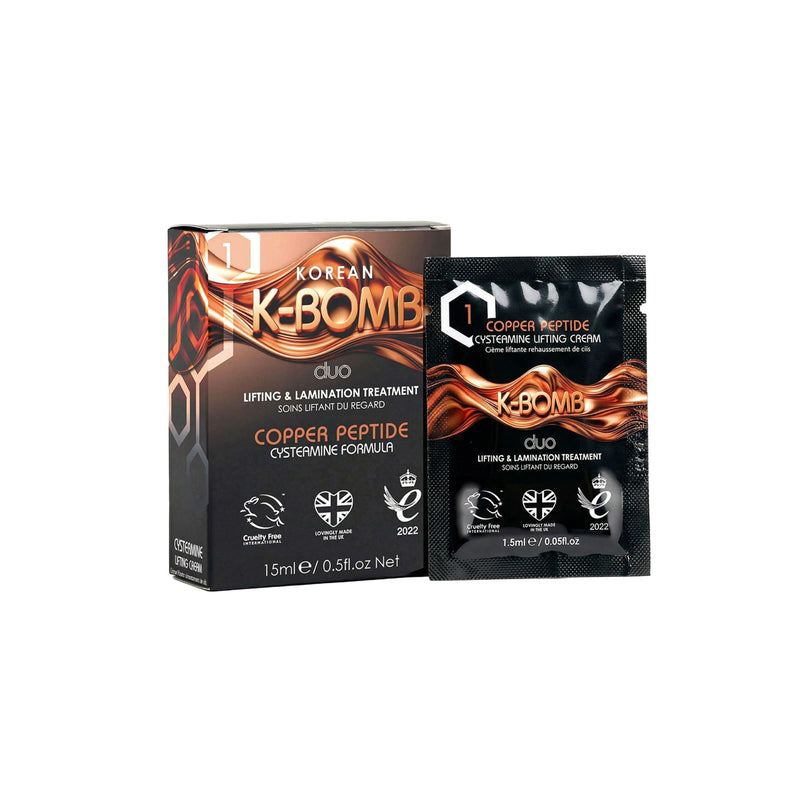
K-Bomb Step 1 Lifting Cream
Cysteamine-based formula for Korean-style lash lifts and brow laminations, built to protect hair health during processing. Copper peptide complex plus quercetin and fisetin flavonoids reduce breakage and add shine. Gently breaks the disulfide bonds for safe reshaping. 10 x 1.5 ml sachets, 7 to 15 minute processing, 6 to 8 week hold. Vegan and cruelty-free. Use with the full K-Bomb system.
Shop K-Bomb Step 1classic vs k-bomb: side by side
| Parameter | Classic BOMB Duo | K-Bomb |
|---|---|---|
| Reducing agent | Ethanolamine thioglycolate | Cysteamine hydrochloride |
| Step 1 pH | 9.0 - 9.5 | 7.5 - 8.5 |
| Reaction kinetics | Faster, stronger grip | Gentler, slower |
| Processing time | 3-7 min (hair-dependent) | 7-15 min (hair-dependent) |
| Added actives | Biotin, niacinamide, proteins | Copper peptides, quercetin, fisetin |
| Best for | Healthy, resistant brows | Fine, fragile, compromised hair |
| Hold | 5-7 weeks | 6-8 weeks |
the glass microbeads in Step 2
One of the most overlooked details in the classic system lives in the neutralizing cream. Suspended in the Step 2 formula are glass microbeads, 5 to 50 microns across, and they do two jobs at once that have nothing to do with the chemistry of bond reformation.
Mechanical separation
The beads act like tiny ball bearings between the hairs. As you work the neutralizer in, they physically keep individual hairs apart, preventing them from fusing together or clumping into what technicians call the "tarantula" effect — spiky, stuck-together brow hairs. A clean, separated finish comes partly from the chemistry and partly from these beads doing mechanical work.
Optical blurring
The beads also scatter light. That diffusion softens the appearance of any small irregularity in the brow line, giving an "optical blur" that reads as a smoother, more natural finish. It's the same principle as a soft-focus filter, built into the cream.
timing is chemistry, not a clock
The pose times below are reaction windows, not arbitrary numbers. They're set by how fast each reducing agent breaks the S-S bonds at its given pH on a given hair diameter. The single most reliable check is not the timer — it's the hair itself.
| Hair Condition | Classic Step 1 | Classic Step 2 |
|---|---|---|
| Very fine or bleached | 3-4 min | 5 min |
| Fine or previously tinted | 4-5 min | 5 min |
| Natural, healthy (medium) | 5-6 min | 6 min |
| Thick, coarse, stubborn | 6-7 min | 6 min |
K-Bomb's window is wider — 7 to 15 minutes — because the gentler pH reduces more slowly. The deeper logic behind how diameter, porosity, tint history, and room conditions shift these brackets is covered in the processing time guide.
Check at 50% of the planned time, not at the end
At half the planned pose time, lift a corner and bend one hair. If it folds to 90 degrees without resistance, the reduction is complete — remove the product immediately, regardless of what the timer says. Urgent removal signs: an ammonia odor, hairs turning pale or bleached, or chaotic frizzing. Any of those means the reaction has gone too far.
safety and the patch test
The chemistry that makes lamination work is also what makes the patch test mandatory. Thioglycolate triggers allergic contact dermatitis in 2 to 5 percent of people, and the only way to find those clients is to test before the chemistry reaches the brow.
The patch test
Apply a small amount of the Step 1 reducer behind the ear or inside the elbow, 48 to 72 hours before the appointment. Any redness, itching, or swelling that develops in that window contraindicates the service. For clients who react to thioglycolate but want a lamination, the lower-pH cysteamine of K-Bomb may be tolerated — but it gets its own patch test, not a pass.
Contraindications
- Absolute: active eye or skin infection, open lesions in the brow area, a positive patch test, and accutane (isotretinoin) use within the last 6 months.
- Relative: pregnancy and breastfeeding (hormonal shifts change hair texture; the gentler K-Bomb is preferred if proceeding at all), eye surgery in the last 6 weeks, and microblading in the last 4 weeks.
Licensing and documentation are state-level in the US
US lamination practice is governed by state cosmetology and esthetics boards, not a single federal cosmetic regulation. Keep your SDS sheets on file, follow your state's licensing and sanitation rules, and document every patch test with date and result. Requirements vary by state — verify yours with your board before adding the service.
aftercare: the 48-hour bond cure
Step 2 closes the disulfide bonds, but they don't fully cure on the spot. The S-S network keeps consolidating for about 48 hours after the service, and anything that disturbs the hair during that window weakens the final shape.
- Zero water or steam: moisture re-swells the cuticle and can break freshly reformed bonds before they cure. No shower spray, sauna, swimming, or steam for 48 hours.
- Zero oils or makeup: oils and brow products interfere with the protein fixation while it's still setting.
- Sleep on your back: a face-down pillow mechanically distorts the new shape while the bonds are still soft.
After 48 hours the bonds are cured, normal routine resumes, and a Step 3 type serum a few times a week extends the result.
glossary cheat sheet
- Keratin
- The fibrous protein that makes up brow and lash hair, built from polypeptide chains held by three bond types.
- Disulfide Bond (S-S)
- The strongest covalent bond in keratin, linking sulfur atoms of cysteine residues. Dictates the hair's permanent shape.
- Cortex
- The inner layer of the hair where the disulfide bonds live. The target zone of every reducing agent.
- Cuticle
- The outer scale layer. Must be opened by raising the scales before a reducing agent can reach the cortex.
- Ethanolamine Thioglycolate
- The reducing agent in the classic BOMB Duo, pH 9-9.5. Slower and gentler kinetics than ammonium thioglycolate.
- Cysteamine Hydrochloride
- The reducing agent in K-Bomb, pH 7.5-8.5. A cysteine derivative that remodels keratin biocompatibly.
- Sodium Bromate
- The oxidizing agent in classic Step 2. Reforms the disulfide bonds in the new shape.
- Glass Microbeads
- 5-50 micron beads in the Step 2 cream that mechanically separate hairs and optically blur irregularities.
- Reduction / Oxidation
- The two-phase cycle of lamination: Step 1 reduces (breaks) the S-S bonds, Step 2 oxidizes (rebuilds) them.
technical questions from the chair
Why are the products dosed in single-use sachets?
Why avoid plastic-wrap occlusion?
How exactly do the glass microbeads work?
Is K-Bomb actually gentler, or is that marketing?
Can a client allergic to thioglycolate use K-Bomb?
What does the suppleness test actually tell me?
Why does sleeping position matter for 48 hours?
two chemistries, one brow chair
The classic BOMB Duo for grip and speed, K-Bomb for fragile and compromised hair. Stock both and match the chemistry to the client instead of forcing one system on every brow.
Shop The Lamination Systems